 BankGPT
Capabilities & artifacts
The typed capability artifact is the contract between the discovery model, the human reviewer, the replay executor, and the calling agent.
The artifact (apps/engine/src/artifact.ts) is the center of the design.
All validation is zod, every type is z.infer, and no replay code is
capability-specific — a capability reads like a function signature, because
that is how the calling agent treats it.
What an artifact contains
- Identity and provenance — stable
id, semverversion,goal,targetApp,risk(safe|risky),createdAt, plusdiscoveryModelanddiscoveryRunIdso every artifact audits back to a genuine discovery run. - Typed I/O —
inputs(string/number/boolean/enum with allowed values, required flags, descriptions) andoutputs. - Ordered steps from a fixed action vocabulary (
navigate,click,type,select,press,wait,extract), each with a reviewer-facingintent,{{input}}placeholder substitution, and an optional per-step checkpoint.extractsteps fill declared outputs. - Strategy-tagged locators with fallbacks. Every step target records a
primary
a11ylocator (role + accessible name) and ordered fallbacks (css,text) with a human-readablerobustnessnote. The locator schema is a strict discriminated union onstrategy. Pixel coordinates are never recorded — they do not survive restyling. - A machine-checkable checkpoint (URL regex and/or visible text and/or a required element) asserted at the end of replay, so the run proves it arrived instead of assuming the last click worked.
- A
businessOutcomesdetect table — named, expected outcomes (member_not_found,invalid_input,session_expired) with URL/text detect rules, so "no such member" is a legitimate answer the caller branches on, not a crash.
A real artifact
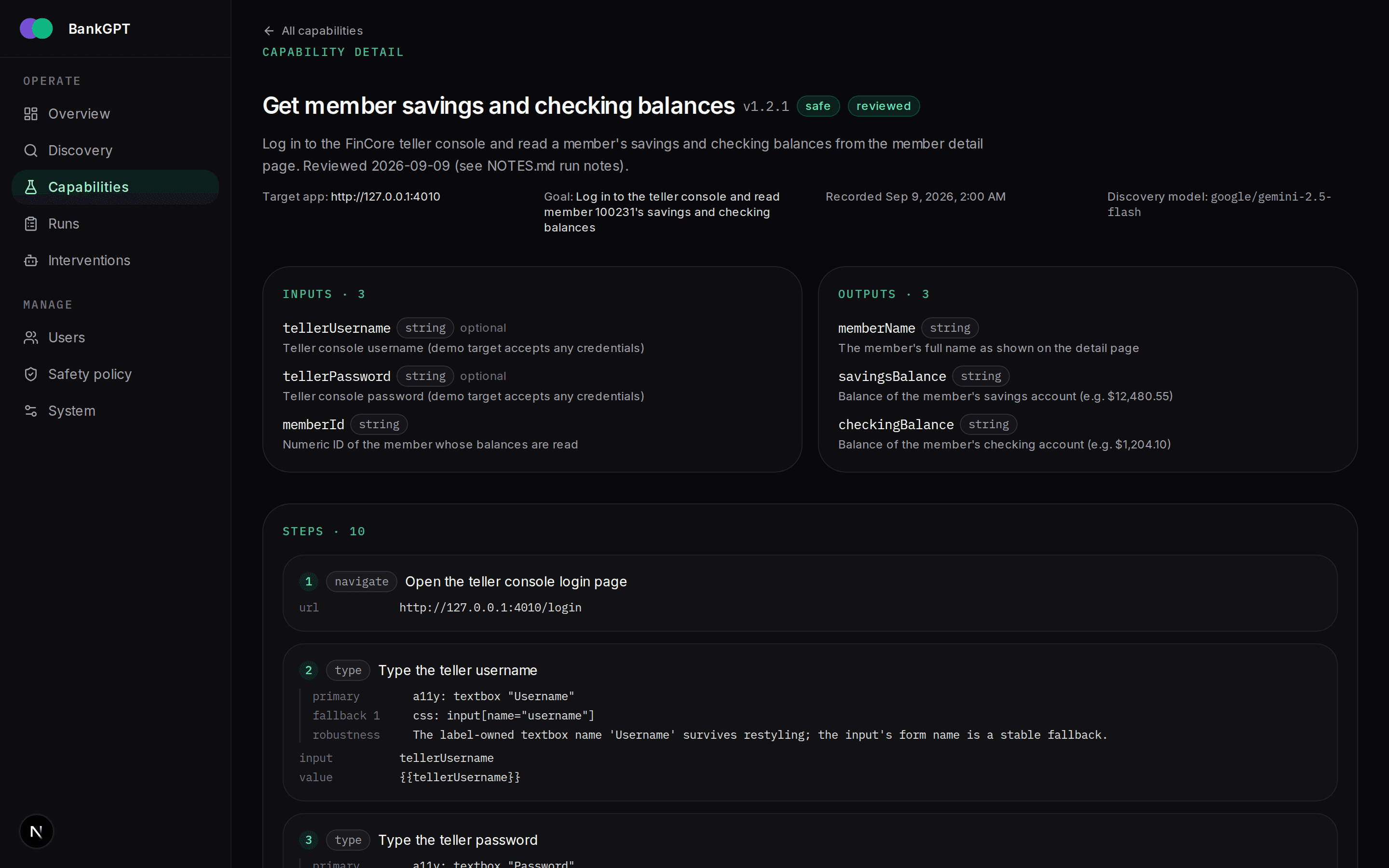
This is the reviewed get_member_balances artifact (trimmed to its
identity, I/O, and first two steps):
{
  "id": "get_member_balances",
  "version": "1.2.1",
  "name": "Get member savings and checking balances",
  "risk": "safe",
  "reviewed": true,
  "discoveryModel": "google/gemini-2.5-flash",
  "inputs": [
    { "name": "tellerUsername", "type": "string", "required": false,
      "description": "Teller console username (demo target accepts any credentials)" },
    { "name": "tellerPassword", "type": "string", "required": false,
      "description": "Teller console password (demo target accepts any credentials)" },
    { "name": "memberId", "type": "string", "required": true,
      "description": "Numeric ID of the member whose balances are read" }
  ],
  "outputs": [
    { "name": "memberName", "type": "string",
      "description": "The member's full name as shown on the detail page" },
    { "name": "savingsBalance", "type": "string",
      "description": "Balance of the member's savings account (e.g. $12,480.55)" },
    { "name": "checkingBalance", "type": "string",
      "description": "Balance of the member's checking account (e.g. $1,204.10)" }
  ],
  "steps": [
    { "intent": "Open the teller console login page",
      "action": "navigate", "url": "http://127.0.0.1:4010/login" },
    { "intent": "Type the teller username",
      "action": "type",
      "target": {
        "primary": { "strategy": "a11y", "role": "textbox", "name": "Username", "exact": true },
        "fallbacks": [{ "strategy": "css", "css": "input[name=\"username\"]" }],
        "robustness": "The label-owned textbox name 'Username' survives restyling; the input's form name is a stable fallback."
      },
      "input": "tellerUsername", "value": "{{tellerUsername}}" }
  ],
  "checkpoint": { "urlPattern": "/members/\\d+$", "visibleText": "Accounts" },
  "businessOutcomes": [
    { "code": "member_not_found",
      "description": "No member exists with the requested ID — a legitimate answer, not a failure.",
      "detect": { "visibleText": "No member found" } },
    { "code": "session_expired",
      "description": "The teller session ended from inactivity; log in again to continue.",
      "detect": { "visibleText": "Session expired" } }
  ]
}
The console renders the same artifact for a reviewer:
Locator strategies
Each step target is a strict discriminated union on strategy:
| Strategy | Fields | When it is used |
|---|---|---|
a11y | role, name, exact | Primary. The accessibility-tree identity of the element; survives restyling, theming, and markup churn. |
css | css | First fallback — a stable form name or structural selector. |
text | text, exact | Last resort — visible text (exact or substring). |
Replay tries the primary locator first, then the fallbacks in recorded order (never a DOM-ordered union), with explicit waits.
The review gate
Discovery stamps artifacts 1.0.0 with reviewed: false. A documented
human review pass fixes the distiller's first-draft semantics before
reviewed: true and a version bump.
- Safe capabilities replay unreviewed.
- Risky capabilities refuse to replay until the artifact is
reviewed: true, and server-invoked risky runs raise an operator approval with maker ≠ checker segregation — the operator who requested the run cannot approve it (same-person decisions are recorded and flagged asself-approved, not blocked, so single-account demos work).
Handoff when automation gets stuck
If replay stalls, a human operator takes over the same live session through the interventions inbox, acts in the browser directly, and hands control back to the automation. Ownership transfer is explicit over the engine's WebSocket control channel — the artifact keeps no hidden state. See Approvals & handoff.
Artifacts live in the engine's capabilities table; every discovery and
replay run's step log, transcript, and failure/handoff screenshots are
stored as blobs in the engine SQLite DB (run_files table) and served over
the engine HTTP API at /runs/:id/evidence and /runs/:id/files[/:name].
See Evidence & storage.