 BankGPT
Approvals & handoff
Maker ≠ checker approvals for risky runs, and the live take-over panel for stuck automation.
Two human-in-the-loop mechanisms keep automation safe without blocking it: approvals gate risky runs before they start, and handoff lets a human rescue a run that is already stuck. Both are explicit, recorded, and enforced by the engine — not by convention.
Approvals (maker ≠ checker)
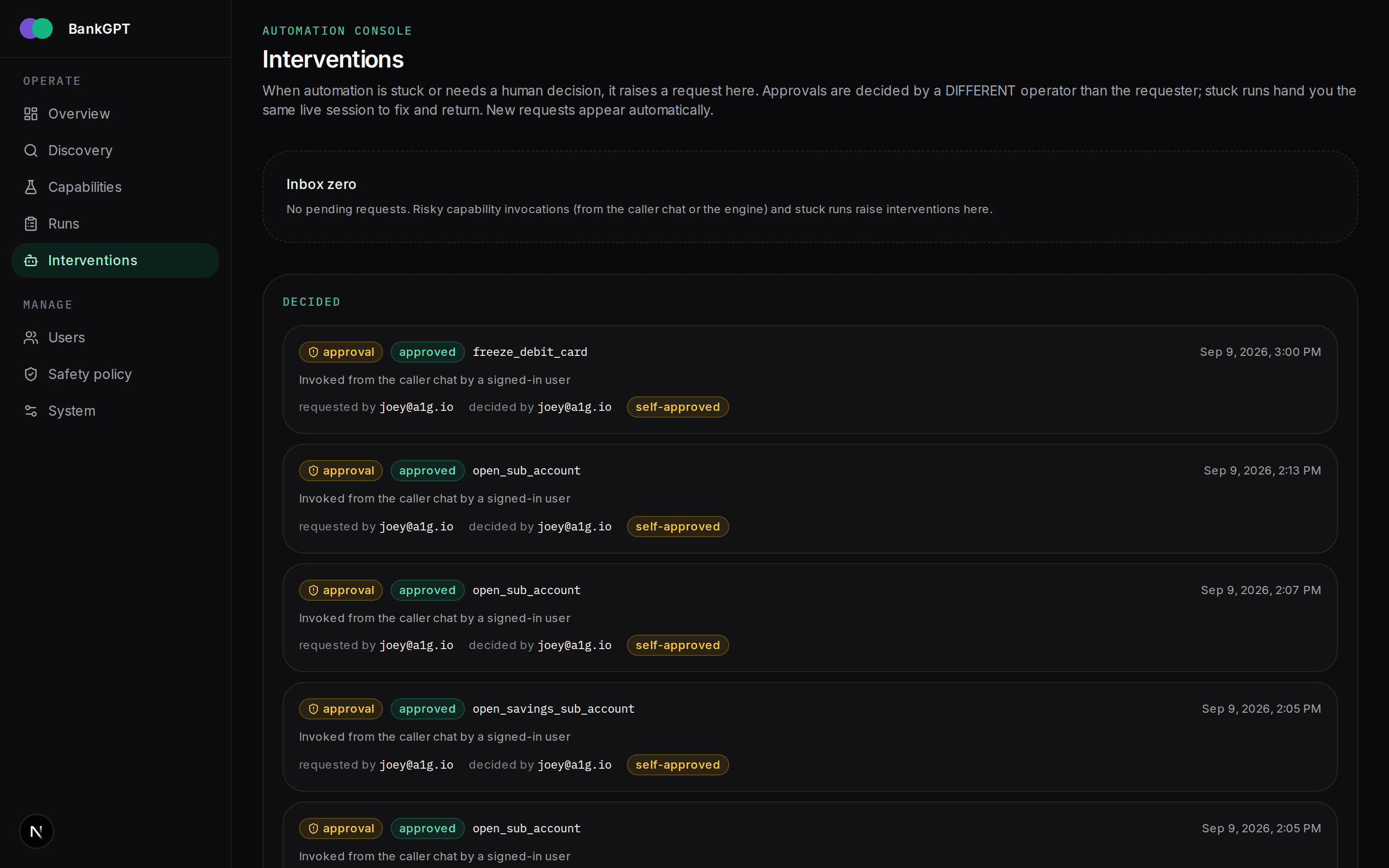
A risky capability never runs on the caller's authority alone. Invoking
one (from the caller chat or the engine API) raises an approval
intervention carrying the capability, its typed inputs, and
requestedBy. A human operator approves or rejects with decidedBy and a
reason; the run executes automatically once approved.
Segregation is recorded and flagged, not hard-blocked: if the same
account requests and decides, the intervention is marked self-approved
so single-account demos still work, but the evidence always says who
decided. In a multi-operator deployment the expectation is maker ≠
checker.
Approval tokens are:
- scoped to one capability,
- single-use (consumed by exactly one run),
- pinned to the artifact version and content hash the request carried, so an operator never approves a run of a mutated or replaced artifact.
The engine's enforcement point is requireApproval: every risky execution
path calls it first, in both discovery and replay.
Handoff (take over the same live session)
When replay cannot satisfy a step checkpoint, it raises a stuck intervention and pauses. A human operator opens the interventions inbox, takes over the same live browser session through the take-over panel, acts in the browser directly, and hands control back. The automation resumes from where it blocked — no restart, no hidden state.
Ownership is an explicit state machine over the engine's WebSocket control channel:
automation ──cede──▶ human ──resume──▶ automation
     │                                  ▲
└──────────── pause ───────────────┘pause— automation stops issuing actions (control staysautomation)cede— control passes to a human operator; automation blocksresume— control returns; automation continues
Runs that may need handoff await waitWhileNotAutomation() before each
action, and every ownership change increments an epoch so a stale
automation aborts instead of acting on a session it no longer owns. Human
actions are recorded into the run's evidence (steps.jsonl +
control.json). A handoff has a timeout (handoffTimeoutMs, default
20 min) so a forgotten take-over fails the run cleanly instead of
holding a browser forever.
The safety policy
The policy (apps/engine/src/policy.ts) is the engine's guardrail set,
viewable at /admin/policy:
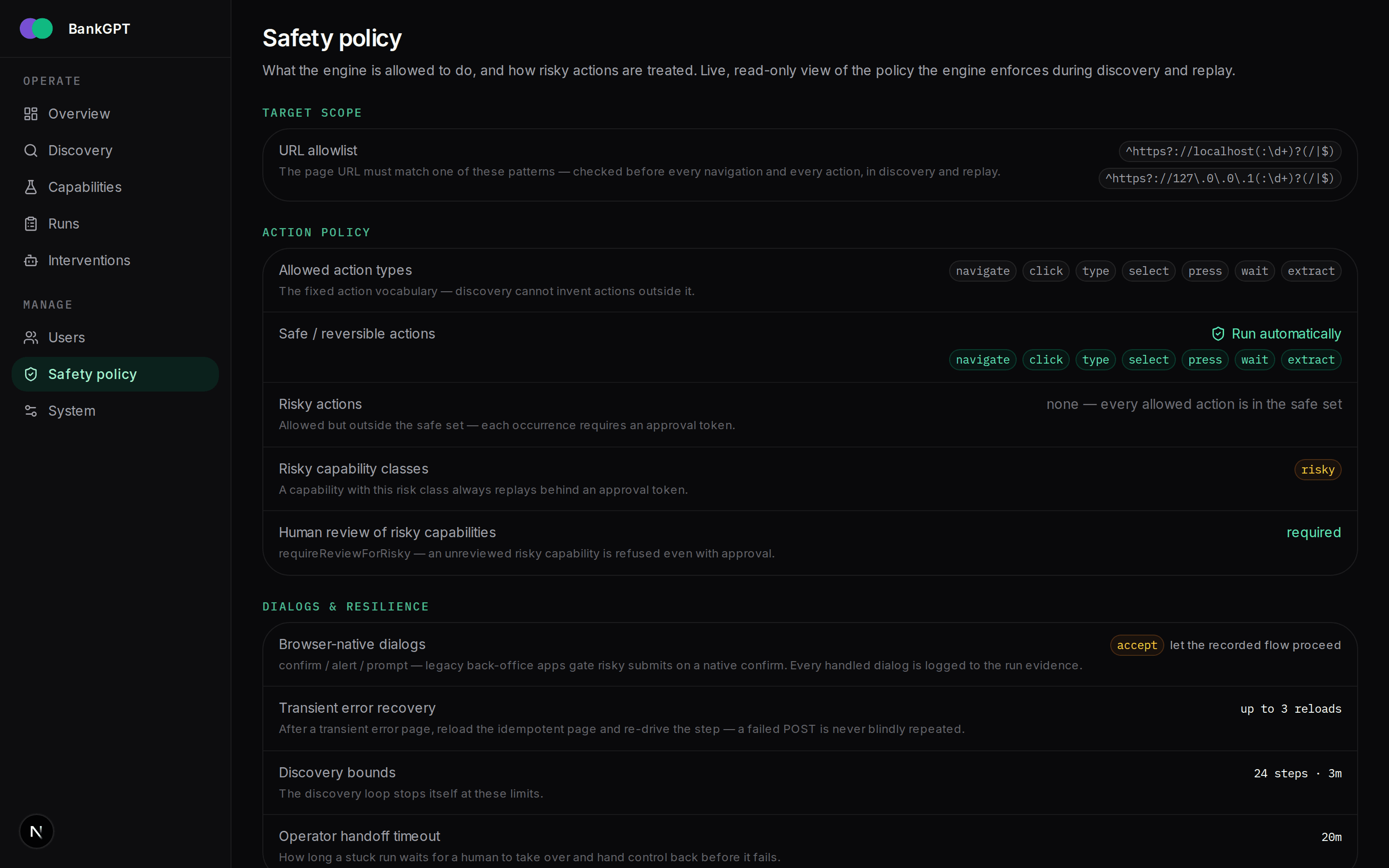
| Field | Default | What it controls |
|---|---|---|
allowedUrlPatterns | localhost / 127.0.0.1 | Regexes the current page URL must match before any action. |
allowedActions | all 7 step actions | Action types the agent may execute. |
safeActions | all 7 step actions | Actions treated as safe/reversible; anything allowed but not here is risky. |
riskyClassesRequireApproval | ["risky"] | Capability risk classes that need an approval token. |
requireReviewForRisky | true | Risky artifacts must be reviewed: true before replay. |
maxDiscoverySteps | 24 | Discovery loop step limit. |
discoveryTimeoutMs | 180000 | Discovery wall-clock timeout. |
dialogHandling | accept | How native confirm/alert/prompt dialogs are answered. |
transientErrorMaxReloads | 3 | Reloads per transient server-error page. |
handoffTimeoutMs | 1200000 | How long a run waits for a human take-over. |
Redaction
Secrets and PII-shaped values never persist into artifacts, run logs, or
evidence. redactText / redactValue scrub credential-shaped and
PII-shaped substrings before anything is written, and every JSON response
leaves the engine through redaction. See
Evidence & storage.